
Sustainable Seafood Production
- Land-based, fully contained aquaculture
- Recirculating Aquaculture Salmon Network
- Reproduction, breeding, hatchery, and trait enhancement technologies
- Disease control
- Sustainable feeds and value-added products
- Aquaculture microbiology
Aquaculture is the fastest-growing agro-industry globally, and in the US, half of all seafood consumed currently comes from aquaculture. Aquaculture must increase production threefold in the next 20 years to fill the growing gap between the increasing demand and declining supply of fishery products. IMET’s research will help aquaculture become more efficient, cost-effective, and environmentally responsible as it increases production to reduce dependence on the declining supply of wild seafood for the growing world population. The IMET Sustainable Aquaculture program focuses on key research areas that address the main biological and technological challenges that aquaculture is now facing.

Land-Based Fully Contained Aquaculture
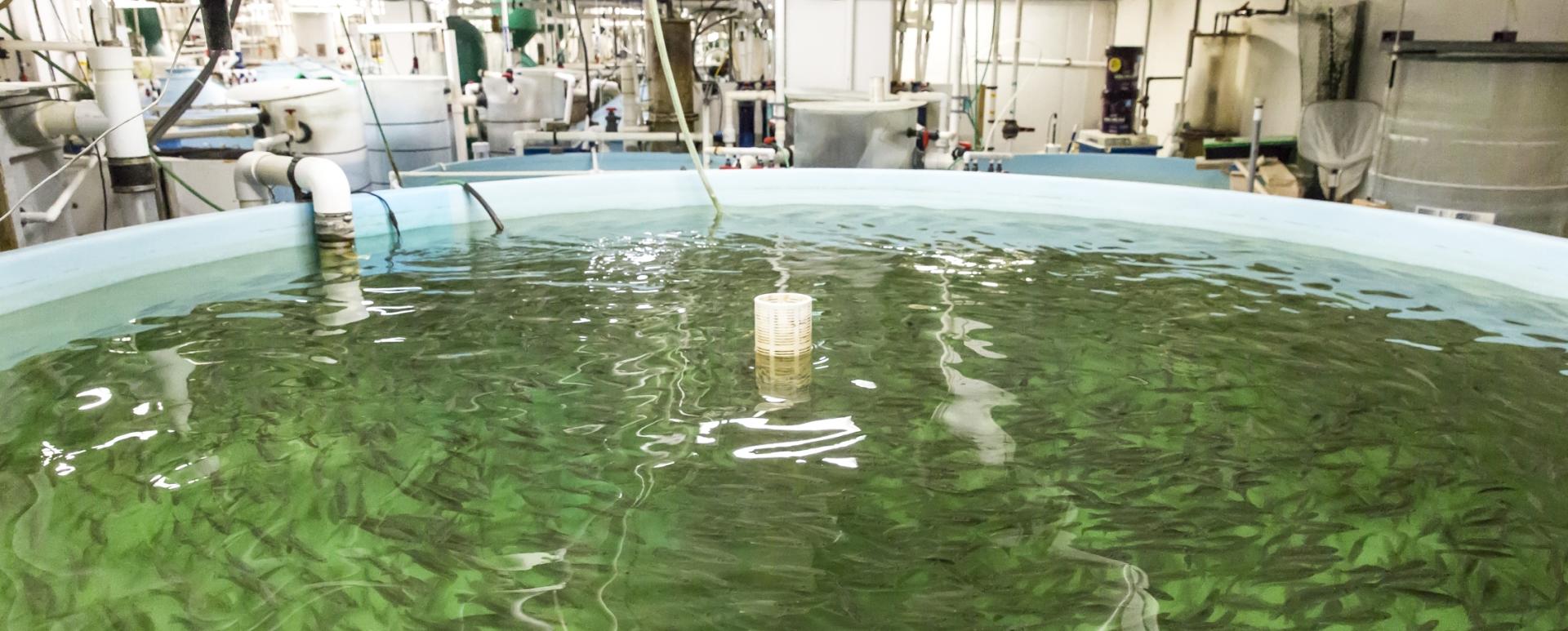
Our Aquaculture Research Center (ARC) provides unique capabilities for research on land-based, fully contained aquaculture systems, focusing on the improvement of biological waste treatment/conversion technologies and aquaculture system engineering. This research will further enhance water quality and increase waste management efficiency for the complementary goals of environmental sustainability, human health, and economic viability.
Recirculating Aquaculture Salmon Network
The mission of the Recirculating Aquaculture Salmon Network is to facilitate the growth of environmentally sustainable and economically feasible Atlantic salmon RAS production in the United States in order to provide better food security and reduce the current trade deficit associated with salmon imports. This project is led by Dr. Yonathan Zohar, UMBC-IMET Professor, Chair of the Department of Marine Biotechnology at UMBC, and Director of the Aquaculture Research Center.
 Reproduction, Breeding, Hatchery, and Trait Enhancement Technologies
The first prerequisite to the introduction of any new aquaculture species is closing its life cycle in captivity, i.e., producing fertilized eggs and viable juveniles on a year-round basis. The IMET faculty's critical mass and expertise in the molecular and endocrine basis of reproduction, development, and growth will enable us to continue our leadership role in understanding the mechanisms responsible for these processes and in developing technologies to enable reliable spawning, larval rearing, and year-round seed production.
The most promising strategy to ensure genetic containment in aquaculture is to generate reproductively sterile fish, so as to alleviate the threat of farmed fish breeding with wild stocks and prevent the possible propagation in the wild of genetically-engineered and non-native species. We will continue our innovative research on understanding the molecular and hormonal basis of sex determination and differentiation, germ-cell and gamete development in both the zebrafish model and commercially important aquaculture species. Our exceptional algal production and live feed capabilities facilitate the integration of the above research goals into a coherent broodstock/breeding/hatchery package to support applied work ready for transfer to the industry.
 Disease Control
Whether for stock enhancement or commercial farming, fish health is critical to the aquaculture industry. Progress in the development of specialized adjuvants and delivery systems will enable vaccines to become even more targeted, specific, and allow for faster responses to emerging diseases. Aquaculture vaccines provide business opportunities and we expect an IMET biotech company to be founded in this area within the next two years. Using synthetic biology, we can tailor efficient vaccines for specific pathogens whose complete genomes are known and, in the future, create disease-resistant hosts via RNA-guided “gene drives”.

Sustainable Feeds and Value-Added Products
Feed costs comprise up to 50% of the total budget for raising fish to harvest, and current feeds use ingredients extracted from wild fishery stocks. IMET is developing sustainable plant and algal-based feeds as an alternative to conventional fish-based feeds, thereby reducing reliance on a limited fishery resource.

Aquaculture Microbiology
IMET faculty engineer microbial communities to improve water quality in recirculating aquaculture systems, control the development of microbial infections, and minimize off-flavor during high-density production. We are also assessing microbiomes of production systems and cultured fish to determine how to control aquaculture microbiota by the use of probiotics as alternative biological water quality and disease control agents.
Researchers working in this area:
 |  |  |  |
| Dr. J. Sook Chung UMCES-IMET | Dr. Helen Dooley UMB-IMET | Dr. Shaojun "Jim" Du UMB-IMET | Dr. Allen Place UMCES-IMET |
 |  |  |  |
| Dr. Keiko Saito UMBC-IMET | Dr. Eric Schott UMCES-IMET | Dr. Harold Schreier UMBC-IMET | Dr. Gerardo Vasta UMB-IMET |
 |  | ||
| Dr. Ten-Tsao Wong UMBC-IMET | Dr. Yonathan Zohar UMBC-IMET | ||